From Noticeboard to Notebook: Keeping a Group Record
A clear group record preserves decisions, disagreements and open questions, helping neighbours understand why a choice was deferred and what needs discussion next.
The common mistake with a group record is to write down every comment but leave out the disagreement that stopped a decision. Later, neighbours may see a proposal in the notes and assume it was approved, or repeat the same debate without knowing what remains uncertain. A useful record captures the point of disagreement and the choices still on the table.
Why record the disagreement?
A concise note should not make a meeting sound more harmonious or settled than it was. If members disagree about a proposed action, that difference may explain why the group deferred a decision or what information it still needs.
Record the substance of the disagreement rather than turning the notes into a transcript. For instance, state that some members support using a site because it is easy to reach, while others are concerned about access for farm vehicles. The record need not name speakers unless attribution is needed and appropriate.
Then make the status clear: was the proposal agreed, rejected, deferred or left open? A sentence such as “Deferred: choose a planting site; members differ over vehicle access, and the group will ask the landowner about possible restrictions” preserves both the disagreement and the next question.
How can a note distinguish debate from a decision?
Use plain status words consistently. Proposed means an idea was raised; agreed means the group reached a decision; deferred means it chose to return to the question; and completed means the agreed action has been carried out.
Include conditions that limit an agreement. “Agreed: ask the parish council whether the noticeboard can move beside the shop; do not move it until permission is confirmed” is different from saying that the move has been approved.
When there is no decision, name what is unresolved and why. “No decision: the group has not agreed whether to close the lane during the planting day; members need to check access for residents and deliveries” is more useful than “Discussed lane closure”.
What belongs in a useful group record?
A record can be brief while still showing how the discussion stands. Include the meeting or discussion date, the subject, the decision status and any important disagreement or condition. Add an action only if someone has volunteered or the group has agreed who will take it.
- Observation: The notes say “move the board” without a status word. If the group approved the move, then mark it agreed and state any conditions; otherwise label it proposed or open.
- Observation: Members raised different concerns about a site. If the disagreement explains why no choice was made, then summarise the competing concerns; otherwise record the decision without unrelated discussion.
- Observation: An agreement depends on permission or another condition. If that condition is still unmet, then state that the action cannot proceed yet; otherwise note that the condition has been met.
- Observation: The record says “sort out the hall”. If the group agreed a specific enquiry, then write what is to be asked and who volunteered; otherwise leave it as an open question rather than implying an assignment.
- Observation: The group has not said when it will revisit an open issue. If a return point was agreed, then record the next gathering or event; otherwise leave the review timing undecided.
- Observation: The note contains private details unrelated to the project. If those details are unnecessary, then remove them from the shared record; otherwise consider whether a separate, restricted record is more suitable.
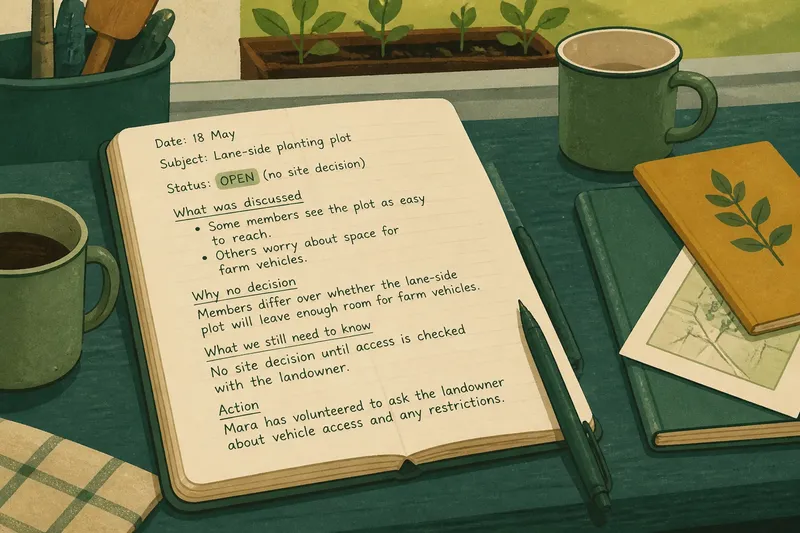
Say you are organising a shared planting day. These are invented details: the group is considering a lane-side plot, and members disagree because one expects it to be easy to reach while another worries that farm vehicles need clear access. The group has not yet spoken to the landowner.
First, record the proposal as open rather than agreed. Next, write the disagreement in neutral terms: “Members differ over whether the lane-side plot will leave enough room for farm vehicles.” Then note the missing information: “No site decision until access is checked with the landowner.” If the group has agreed that Mara will ask, record that she volunteered to do so; if nobody has taken it on, do not assign the task in the notes. The resulting record tells the next gathering why the choice remains open and what answer would help the group decide.
Where should neighbours keep the record?
Choose a location members can actually use: a labelled notebook in the village hall, a folder in the community shed or a shared document. A noticeboard copy may help members who do not use online channels; a digital file can be easier to update and search.
Agree on one main location. If paper and digital copies are both kept, state which one is current and who updates them. Otherwise, people may find different versions and be unsure which reflects the group’s latest discussion.
Keep the record limited to what helps members understand the group’s work. Do not put sensitive personal details on a public noticeboard. Where legal, financial or personal records matter, follow relevant requirements and seek qualified advice if needed.
Which questions do groups ask about records?
Do informal groups need formal minutes?
Many groups can use concise notes of decisions, disagreements and unresolved questions instead. Any formal requirements depend on the group’s arrangements, so check those where relevant.
Should every speaker be named?
Usually, a neutral summary of the concern is enough to explain why an issue remains open. Name someone only when attribution is necessary, such as recording who has volunteered for an agreed action.
How should a group correct a disputed note?
Ask members to identify the specific wording they believe is inaccurate and what should replace it. Amend the shared record transparently, so readers can see that the account was corrected rather than silently changed.
How long should records be kept?
Keep notes while they help members understand ongoing decisions and commitments, and follow any applicable requirements for significant records. If legal, financial or personal obligations are involved, seek qualified advice.
How can a group record stay fair and useful?
Use neutral wording and distinguish what the group decided from what members still need to consider. A record should not settle a disagreement by making one position sound like the group’s view, nor should it assign work that nobody accepted.
For keeping a group record, check that a member who missed the conversation can tell what was decided, what disagreement remains and what information could help resolve it. That small distinction gives the next discussion a more accurate starting point.